 Heating technology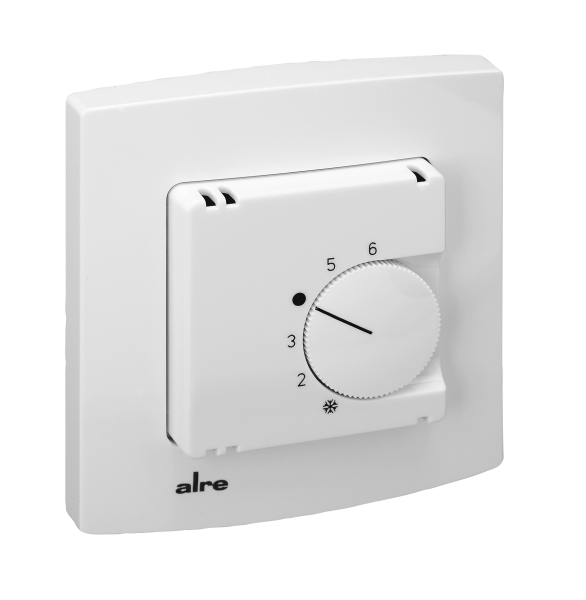
 Air conditioning
 Radio systems
 System technology
 Building automation
 Sensors


Glossary
Terms explained simply and clearly
On these pages, you will find technical explanations and definitions of terms.
2
2-point control (on/off control)
A control algorithm that, for example, shuts off the output when the setpoint temperature is exceeded and turns it back on when the temperature falls below the setpoint. The temperature in the room is always subject to certain fluctuations (control deviations). These fluctuations result from the controller’s switching temperature differential and the characteristics of the room, such as heating rate, heat loss, etc.
3
3-point rule
With a 3-point control system, the system can switch between the operating modes of heating, neutral zone, or cooling.
A
Actuator
An electrically controlled valve used to regulate, for example, the flow of hot water in heating systems. These valves are categorized into on/off actuators and proportional actuators. Proportional valves are designed for use with controllers that provide continuous control.
Air conditioning, 2-pipe fan coil unit:
The two-pipe air conditioning systems are supplied with heating or cooling water as needed through the same piping system via two pipes (supply and return).
Air conditioning, 4-pipe fan coil unit:
The 4-pipe HVAC systems are supplied with heating or cooling water as needed via a heating or cooling circuit (4 pipes).
B
Bimetal
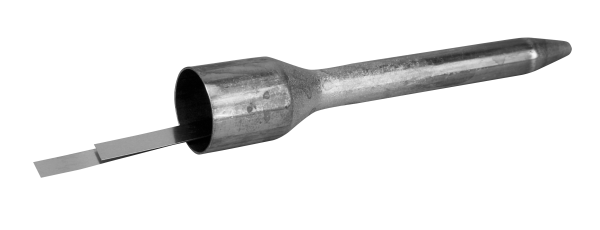
Thermobimetal is generally composed of layers of metals or alloys of roughly equal thickness that are firmly bonded together and have different coefficients of thermal expansion. As a result, it bends in response to temperature changes such that, when heated, the side containing the component with the lower coefficient of thermal expansion becomes concave. Heat is transferred from the environment by conduction, radiation, or convection (indirect heating).
C
Check valve
A reversing valve (4-way valve) enables a reversing cycle by causing the condenser to act as an evaporator, allowing the refrigeration unit to warm up or defrost.
Continuous control
The controller provides an analog output signal. The value of the output signal changes continuously—that is, without any sudden jumps—in response to the input signal.
Cooling ceiling
The cooling ceiling is a type of surface heating system. Cooling ceilings are frequently used in office spaces for passive cooling. In this system, cool water (usually 16 °C) flows through a network of pipes, cooling the air in the room. Lower flow temperatures are not possible due to the risk of condensation.
D
Defrosting
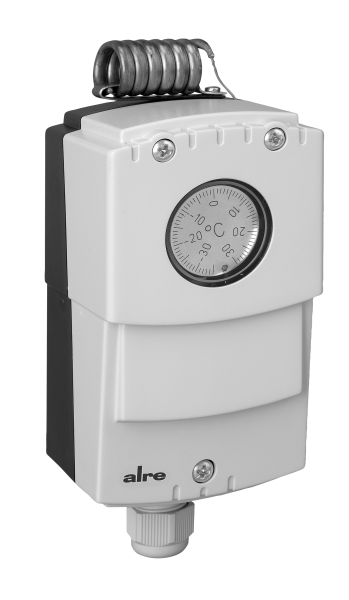
Defrosting refers to the regular de-icing or heating of heat exchangers or cooling units to maintain the system’s efficient operation. Intrinsic safety (JTU, JTL) Intrinsic safety / cold protection: The units are intrinsically safe, i.e., if the sensor medium is lost—e.g., due to a sensor break—the burner is shut off. Since sub-zero temperatures produce the same effect due to the volume reduction of the sensor medium, the units are adjusted using the “cold screw” so that they only shut off the burner at temperatures below –15°C. The burner can only be restarted manually at temperatures higher than approximately –5°C using the manual reset button.
E
Evaporator/Condenser
A condenser is a heat exchanger in a refrigeration system in which a vaporous medium is liquefied by removing heat. In most cases, the refrigerant undergoes further cooling within the condenser. In accordance with the definition in the German translation of the European standard EN 378 Part 1, the condenser in refrigeration systems is referred to as a condenser to distinguish it linguistically from an electrical capacitor. The evaporator performs the reverse process by vaporizing the liquid medium through the addition of heat.
H
Heat pump
Heat pumps can be used to cool or heat rooms. Modern systems enable efficient heating and cooling because they allow for reversible operation.
M
Mechanical restriction
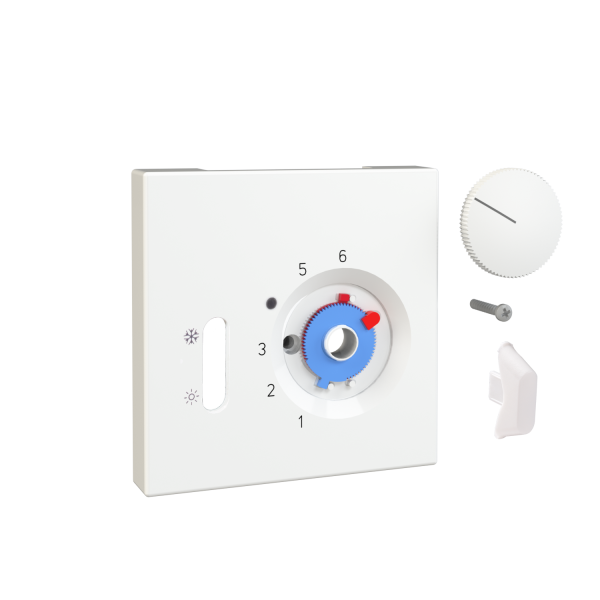
Below the adjustment knob are “adjustment tabs” (red/blue) for mechanically setting minimum and maximum temperature limits within the adjustment range. This prevents unintended changes to the setpoint, for example in children’s rooms or public buildings.
N
Neutral Zone
The “neutral zone” refers to the control range in which neither heating nor cooling takes place.
Normally open contact (bimetal)
Normally open contact (bimetal): The control contact closes as the temperature rises and opens again as the temperature drops (for “cooling”).
P
Proportional band (p-band)
The proportional band is a range around the setpoint within which the controller provides a continuous output signal. This means that the controller keeps the room temperature nearly constant within the proportional band (provided the heating capacity is sufficient).
PWM (Pulse Width Modulation)
A method for generating a quasi-steady-state transfer response of a controlled system. By varying the duty cycle at the input, the time constant of the transfer system generates a quasi-steady-state signal waveform at its output.
S
Split-type air conditioner / Multi-split air conditioner
Split-type air conditioners consist of at least two heat exchangers, one of which is installed as an evaporator in the rooms to be cooled, while the other serves as a condenser to dissipate heat. Most split-type units allow for reverse operation to heat rooms when heat is needed. Multi-split systems consist of several evaporators connected to a single condenser.
Striker (bimetal)
The normally closed contact opens as the temperature rises and closes again as the temperature drops (for “heating”).
Switch (bimetallic)
This is a changeover switch with a normally open and normally closed contact. It functions as described for normally open and normally closed contacts.
Switching differential (hysteresis)
The difference between when the heater or controller turns on and off.
a) There is the controller’s switching temperature differential—this depends on the device’s design.
b) There is the switching temperature difference of the room—this depends on the behavior of the entire controlled system, i.e., the floor structure, the influence of external heat sources, the controller’s installation location, and the controller itself. The switching temperature difference always refers to the controller. It does not indicate the actual switching temperature difference of the controlled system. This varies depending on the installation location and conditions. The temperature in the room is always subject to fluctuations. These fluctuations result from the controller’s switching temperature difference and the characteristics of the room, such as heating rate, heat loss, etc.
T
Temperature reduction (TR)
The TA is also implemented via a resistor, as with thermal feedback. This resistor is activated by a manual switch or a timer. This causes the bimetal strip to sense a temperature approximately 4 K higher than the actual room temperature. As a result, when the controller is set to, for example, 20°C, the room temperature can drop by 4 K to a maximum of 16°C. If the temperature drops further, the heating turns back on, and when it exceeds 16°C, it turns off again. The extent of the actual temperature reduction depends on the building’s insulation and the duration of the reduction period (one night, weekend, vacation).
Thermal recycling (RF)
An additional heating resistor ensures that the thermostat switches off in good time during the heating process. This reduces overshoot in the room temperature and results in a smaller setpoint difference.